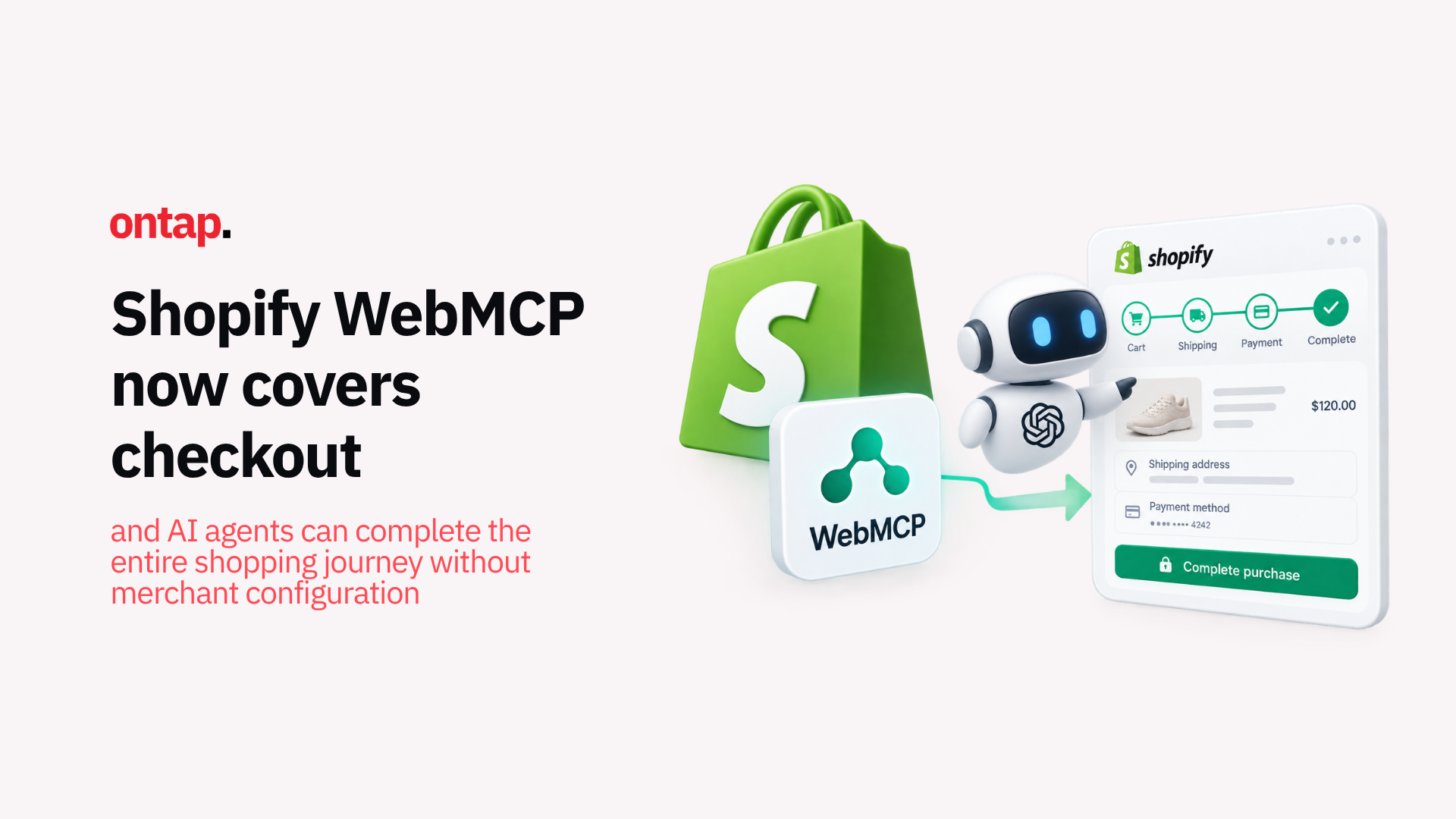
On 28 September 2026, Shopify announced WebMCP support for checkout. Together with its existing storefront and cart tools, this lets compatible browser-based AI agents assist shoppers from product discovery through checkout and order confirmation in supported flows.
The checkout tools require no merchant configuration. However, support depends on the storefront, browser agent and checkout type. Buyer confirmation is still required before an agent places an order.
For merchants, the update extends agent-assisted shopping into an important part of the purchase journey: checkout on their existing store.
What WebMCP checkout actually enables
WebMCP, or Web Model Context Protocol, is a proposed web standard that lets browser agents interact with websites through structured tools. Shopify’s checkout extension adds four tools:
-
Navigate to storefront:
navigate_to_storefrontreturns the buyer to the storefront from checkout; -
Read checkout:
get_checkoutreads checkout state, messages and post-completion order details; -
Update checkout:
update_checkoutupdates supported checkout fields; -
Complete checkout:
complete_checkoutsubmits checkout after buyer confirmation.
The tools operate within Shopify’s checkout application and share its state. They do not introduce a separate checkout API for merchants to configure.
According to Shopify’s Checkout WebMCP documentation, buyers still handle interactions such as Shop Pay login and payment challenges. Agents must obtain buyer confirmation before submitting the order. App-defined checkout extension interactions also require the buyer to use the checkout page.
Shopify’s checkout eligibility guidance excludes:
-
Standard three-page checkout, unless the buyer checks out with Shop Pay;
-
B2B checkout;
-
Embedded checkout and checkouts in mobile checkout SDKs;
-
Checkouts containing merchandise from another shop;
-
Draft orders, order edits and payment collection.
These limits matter particularly for merchants running B2B or custom purchasing journeys.
Why this changes the competitive landscape
Shopify introduced WebMCP support for Liquid and Hydrogen storefronts on 5 August 2026. Those tools let compatible agents search products, manage carts and take shoppers to checkout. The September update extends that support into eligible checkout flows.
This gives shoppers another way to buy through a merchant’s existing store. Whether it improves conversion will depend on adoption, compatibility and the customer experience; the announcement does not establish a sales uplift.
Other agentic commerce developments involve different parts of the journey:
-
AI shopping interfaces: On 16 September 2026, Tapestry announced purchasing through Google Search and Gemini for Coach and Kate Spade products in the US, using UCP-powered checkout;
-
Agent payments: On 8 September 2026, Stripe announced Meta Muse’s integration with Link, following agent-wallet announcements for Grok Bot and Instinct.
WebMCP focuses on agents operating in the shopper’s browser, with the merchant’s checkout remaining the transaction surface. It complements other approaches: Shopify also offers Agentic Storefronts for AI channels, and co-developed the open Universal Commerce Protocol with Google.
What this means for merchants
Shopify says its storefront WebMCP tools require no installation or configuration on Liquid storefronts and storefronts built with the Hydrogen developer preview. As of 6 October 2026, the documentation says agent support is limited to Chromium-based browsers. Checkout eligibility must be checked separately.
No configuration is required for eligible checkout tools, but On Tap recommends reviewing how supported journeys work on your store:
-
Checkout extensions: App-defined interactions remain buyer tasks. Test required fields and extension handoffs, and simplify unnecessary steps while retaining useful functionality;
-
Product data: Keep attributes, pricing, inventory and variant information accurate. Shopify’s Q1 2026 analysis found that more than half of AI-referred sessions started on product pages. That supports attention to those pages, but does not prove which stores agents will select or how WebMCP affects sales;
-
Analytics: Shopify’s session measurement update rolled out from 21 to 23 September 2026. Identified bot sessions are filtered out by default in session-related reports. Shopify advises treating comparisons across the update as a measurement change. Do not assume this filter identifies all agent-assisted purchases;
-
Checkout performance: Test loading times, validation and recovery from errors. Agents can assist with supported fields, but buyers still need to complete required interactions and confirm the purchase.
These reviews should establish what works for your customers before you make changes based on expected agent usage.
The bigger picture: Shopify is extending its agentic commerce infrastructure
Shopify’s storefront, cart and checkout WebMCP tools support successive stages of browser-assisted shopping. Alongside Agentic Storefronts and UCP, they offer merchants different ways to participate in agentic commerce.
Other platform updates support data and integration workflows:
-
Events support: On 26 August 2026, Shopify added Events topics for Metaobject, MetafieldDefinition, MetaobjectDefinition and InventoryTransfer, enabling apps to respond to changes in those resources;
-
Product identifiers: Shopify’s multiple-barcode update, announced on 8 September 2026 for the 2026-10 Admin GraphQL API, supports multiple identifiers for a variant.
These updates have useful applications beyond AI shopping. They should not be treated as evidence that every store is accessible to every agent.
For merchants, the practical implication is that the existing store can support another purchasing route where compatibility and eligibility allow. Accurate data, clear checkout steps and reliable measurement are sensible foundations; the commercial benefit needs to be assessed using your own results.
What to do this week
Start by confirming whether your storefront and checkout flows are supported. On Tap recommends the following checks:
-
Review checkout extensions: Test buyer handoffs and identify unnecessary interruptions;
-
Audit product data: Check attributes, inventory, pricing and variant information for accuracy;
-
Check analytics: Keep bot-filter settings consistent and account for the September measurement change when comparing periods;
-
Talk to your development team: Test eligible flows with a compatible agent, including buyer confirmation, payment challenges and order confirmation.
Prioritise demonstrated issues in your own store over assumptions about how much agent-assisted traffic you will receive.
About On Tap
On Tap is a growth-focused eCommerce consultancy helping mid-market and enterprise merchants improve their digital commerce operations. Product data, checkout performance and analytics are practical starting points for assessing readiness for agent-assisted shopping.
To discuss what WebMCP means for your store, get in touch.